




The artistry of Miguel Zenón keeps flourishing.
And it keeps coming.
That’s a good thing.
As one of his generation’s leading jazz alto saxophonists, not only has Zenón developed an inimitable style and a formidable technique.
He has also been prolific.
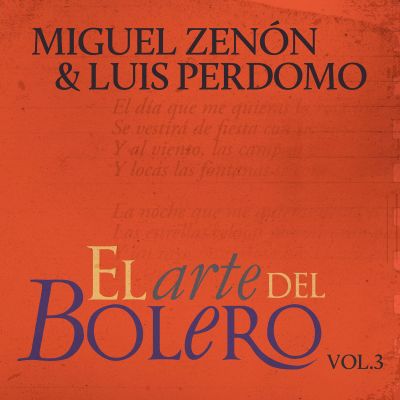
El Arte del Bolero, Vol. 3 represents Zenón’s nineteenth album since he first astounded listeners when his first album as a leader, Looking Forward, was released in 2002.
In addition, Zenón has appeared on seventy other recordings as a member of an orchestra or a collective—most notably his fifteen years with the SFJAZZ Collective—and as a sideman on other musicians’ albums.
A jazz prodigy, Zenón received recognition early in his career.
In 2008—at the age of 32 and after he had released just four albums—Zenón received both the Gugenheim Fellowship and the MacArthur Fellowship, whose board of directors called the award “an investment in a person’s originality, insight, and potential.” Always prescient in its choices, the MacArthur Fellowship has also honored early in their jazz careers Jason Moran, Regina Carter, Vijay Iyer, and Cécile McLorin Salvant.
Grateful for his early recognition, Zenón used part of the MacArthur Foundation’s award to establish a series of concerts in rural regions of Puerto Rico as payback for his own cultural enrichment as a child there. Also, Zenón continued throughout the ensuring eighteen years to provide more cultural and musical originality/insights through his activities as a composer, guest artist, album producer and performer, cultural impresario, master class lecturer and educator, and jazz concert musician.
The MacArthur Foundation’s award presentation included the observation that Zenón was “creating an entirely new jazz language for the 21st century.” Indeed, he was, as Zenón admitted: “I had to learn the music of my homeland from zero. That became my road. The truth is in the music. I’m still learning so much.”
Zenón’s “road”—his “learning process”—may be the catalyst of jazz and Puerto Rican native music. Each of his albums remains consistent. Yet, each provides an outgrowth from the same roots…a blossoming…of exquisite interpretive originality.
Now, the year of 2026 offers the culmination of Zenón’s constant musical activities: a “golden year,” so to speak, for the composer of Golden City. At a time when producers find previously unknown taped recordings of jazz masters in their prime—such as Yusef Lateef or Bill Evans—and release them commercially, Zenón’s growing discography provides contemporary opportunities to enjoy his music that no doubt will continue to increase in future appreciation.
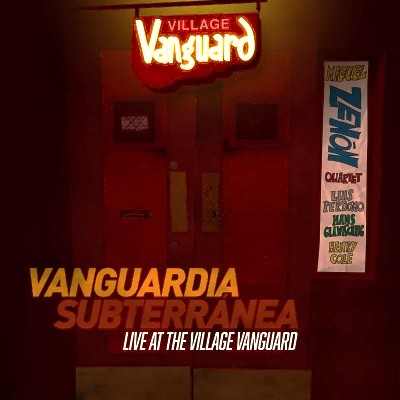
The El Arte del Bolero series—the second album of which deservedly received a Grammy award as the Best Latin Jazz Album in 2024—expands in number and in depth Zenón’s and pianist Luis Perdomo’s recorded repertoire of boleros: a romantic lyrical musical form that Pepe Sánchez is credited with originating in Cuba before it spread throughout the world.
Zenón and Perdomo perceive the bolero as a unique art form, as the titles of their albums make clear and as they explicate their belief through their performances.
On El Arte del Bolero, Vol. 3, Zenón and Perdomo interpret even more instances of the art form. The album’s songs extend from the early twentieth-century influence of Argentinean singer Carlos Gardel until his fatal injuries from an airplane crash in 1935; to Pablo Milanés, a multi-faceted Cuban singer whose creativity progressed through several phases from the fifties until he passed in 2022.
Zenón and Perdomo’s adaptation of Gardel’s “El Día Que Me Quieras” (“The Day That You Love Me,” recorded in 1934 before popular singers and classical tenors around the world discovered it) infuses their respectful, thoughtful performance with jazz harmonies, a key change, and lyrical improvisation. Zenón had mentioned that he and Perdomo would “just go in and play” what Joe Lovano calls “the song within the song.”
Their attention to the alterations that the bolero underwent as it merged with other countries’ music genres encompasses a song from the Filin movement, Bienvenido Julián Gutiérrez’s “Convergencia.” The song’s title itself (“Convergence”) suggests the Filin style’s reversal of influence. Some of the techniques of American jazz singers, such as Ella Fitzgerald—as well as the close harmonies of Clare Fischer—modified the approach to the bolero, even as its relaxed romantic style remaining constant. Perdomo personalizes the song with the outpouring of his flowing solo before Zenón returns at the conclusion to restate the melody.
As the album’s first track, “La Gloria Eres Tú,” (the favorite song of Zenón’s wife) commences with his cadenza—which, as a song without words, pauses between each lyrical phrase. His and Perdomo’s pensive approach to the song of José Antonio Méndez, a founder of the Filin movement, allows its lyrics to drive their interpretation. Both the alto saxophonist’s and the pianist’s versions play and then pause, play and then pause, play and then pause, to accentuate the lyrical meaning of the song, whose changes are similar to those of “I Could Have Told You” and “Just Friends.”
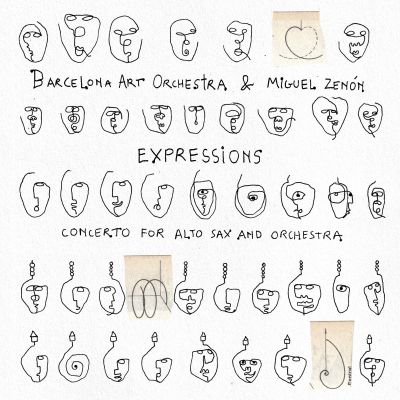
With the concomitant release of Expressions: Concerto for Alto Sax and Orchestra, Zenón’s extensive experience with orchestras merged with his “new jazz language for the 21st century.” The four-part extended composition was written specifically for his featured performer status with the Barcelona Art Orchestra.
Prolifically in 2022, the eighteen-member orchestra started its six-album discography with “Ragtime Stories,” on which its composers—conductor/pianist Néstor Giménez, conductor/pianist Lluís Vidal, clarinetist/saxophonist Lluc Casares, and drummer Joan Vidal—recall from a Catalan perspective a jazz tradition through their own original pieces, such as Casares’s “Ambidextrous Rag,”. Even as the four composers decided upon the pieces’ concepts and wrote the music, in true collective spirit, they leave space for the musicians to add their own individual musical thoughts.
Though of one mind in concept, the creators nonetheless wrote a monumental concerto of four separate movements.
Recorded live at Barcelona’s Room 2 Oriol Martorell, L’Auditori in November, 2025, Expressions, which indeed showcases Zenón’s artistry, exemplifies the Orchestra’s collective approach that contributes to the unpredictable but fascinating variety of its works. The project arose not only from the four same imaginative composers, but also from four separate but connected themes that characterize emotional ranges: silence to screaming, singing to speaking, whispering to fright, and lamenting to outcry.
The emotional opposites that the composers depict outline the scope of the work and prescribe the feelings covered by the performance.
The fact that the composers wrote Expressions specifically for Zenón explains their appreciation for his style and why he was chosen for the recording. No doubt, they heard all these emotions, and more, in his music.
Giménez’s “Silenci/Xiscle” introduces the work with contrasts between Vidal’s gently tentative treble-clef tones and the orchestra’s responses of oblique harmonies and free improvisation, suggesting a mesh of conversation. Zenón enters lyrically at 2:43 over Miguel Casanova’s pedal-point lines before the piece’s tempo, volume, and intensity increase at 4:58, when Zenón rises in fact to a scream. The tension of the orchestra’s forcefully percussive chromatic ascent resolves at 8:44 when the mood accelerates to a fast-paced call and response between Zenón and the orchestra. The deceleration at 9:55 introduces Vidal’s in-the-spirit drum solo of various textures and moods. At 13:40, Zenón begin what would seem to be improvisation over straight four’s with walking bass lines. Instead, his solo is just the start of a thrilling section of ever-increasing speed, accented by the orchestra’s tones of broad colors and punched accents. The piece evaporates almost to silence over, once again, Casanova’s slowly paced pedal point.
Again, Vidal’s brief piano solo of flowing arpeggios introduces Casares’s “Canta/Parla” before the orchestra comes in with a magnificent blend of unfolding colors, as if painting a sunrise. At :49 Zenón enters this track with soft cadenzas. Then at 1:12, the rhythm section establishes a sauntering pattern over which the orchestra sets up a motive of jazz harmonies more conventional than the vocal imitations of “Silenci/Xiscle.” More light-hearted and flowing, “Canta/Parla” proceeds in a more linear fashion, somewhat akin to Gil Evans’s voicings. A platform for not only Zenón’s musical ideas, the orchestra’s trombonist Alba Pujals and guitarist Vincent López “speak” too. After fanning out into an iridescent prism of color, at 9:43, Zenón returns the piece to its original theme.
The title of “Xiuxiueig/Esglai” [“Whispering” to “Fright”], written by Joan Vidal, accomplishes the sounds of emotional extremes. It starts with the calm tremolos of Anna Pujol’s flute, Gabriel Amargant’s and Lluc Casares’s clarinets, as well as the string quartet’s whispering of a chord. The track continues at :52 with the ominous bass-line vamp in seven-four. The dark mood and Brubeckian oblique harmonies recall theme songs from television detective shows of the 1950s, such as Mr. Broadway. After the orchestra has established the shadowy atmosphere, at 3:55 Zenón adds the cool smoothness inherent in the theme. Suspense builds to the “fright” at 5:40, when López develops a quicker vamp and eventually his own stirring solo. Rather than a slow buildup from “whispering” to “fright,” “Xiuxiueig/Esglai” alternates between the two opposites while retaining its overall feeling of mystery.
Instead of employing melodic expressiveness like JJ Johnson’s, Lluis Vidal’s “Lament” section captures the wordless sounds of lamentations as the string instruments’ rubato tones descend. Zenón’s spare melody emerges when the instruments’ individual stringed cries merge into a single expression of sorrow at 1:52. Then at 6:45: the outcry, depicted with louder howls of mourning. Zenón himself wails before the entire orchestra backs him with bursts with final harmonized jolts of grief.
Though the emotions described musically on Expressions vary, as do the composers’ musical personas, everyone adheres to a consistent aesthetic plan. Each of the four tracks effectively describes the extremes of human feeling. The separate movements not only highlight and challenge the orchestra’s musicians, but also travel through sometimes complementary and sometimes divergent musical sections.
The matching of Zenón’s inimitable abilities with the Barcelona Art Orchestra’s ambitious work covering the wide expanse of human expressiveness results in a singular performance that amplifies the admirable accomplishments of both.
And once again, Zenón exceeds the hopes of his early supporters.
Artist’s: www.miguelzenon.com
Artist’s Web Site: www.barcelonaartorchestra.com
Retail Web Site: https://miguelzenon.bandcamp.com/album/el-arte-del-bolero-vol-3