











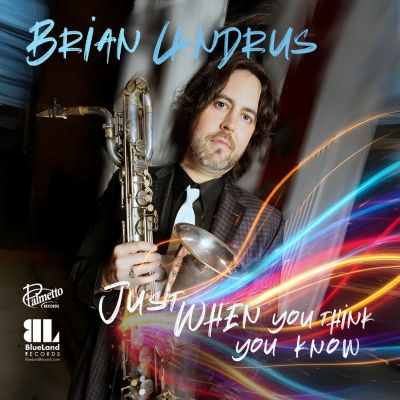
A thoughtful composer as well as an original voice on a wide range of woodwind instruments, Dr. Brian Landrus has released an album that may expand upon listeners’ expectations. Landrus’s personal experiences confirm that life itself confounds expectations.
His new album, Just When You Think You Know, summarizes Landrus’s deepening realization that nothing stays the same, perhaps due to the increasing acceleration of changes.
Like Janus of the two faces, the Roman god of transition, the name of Landrus’s album suggests two perspectives of the same experiences: change and evolution. The lessons of past experiences, good or bad, can lead to enriched understanding and growth, rather than sustaining the complacency that arises from repetition.
And so, Just When You Think You Know contains some surprises that support Landrus’s point.
For one thing, he has expanded his array of instruments to include the tenor sax and the C flute. For another, the pensive bearing of Landrus’s album differs from the emotions of previous albums, such as the environmental urgency of Red List. And his vision for Just When You Think You Know, performed by his quintet, varies from that of his previous albums—such as his long-form compositions for a 25-piece orchestra on Generations.
The consistent impressions of Just When You Think You Know are contemplation, heightened awareness, and emotional resolution. To accomplish the musical realization of these impressions, Landrus had written comforting pieces on which he applies the broad spectrum of colors and textures that each of his six instruments offers.
With musical restlessness, compositional integrity, artistic confidence, and instrumental command, Landrus has developed a recognizable style of his own, no matter which instrument he plays. As a result, appropriately enough, Landrus has been recognized as one of this generation’s leading jazz musicians.
After listening to the entire album, it becomes apparent that all the compositions on Just When You Think You Know fit into an overriding theme, as if written as parts of a suite describing Landrus’s personal and musical progress.
For instance, one part of the “suite” consists of Landrus’s dissatisfaction early in his musical career when he toured with popular groups like The Beach Boys and The Temptations. Even though the work was steady and the money was good, the music’s sameness in every concert did not provide the challenge or growth that Landrus sought.
“Untold Story” appears to unfold the story, whose title implies that Landrus may have kept it to himself until now. With patient musical explication and long background tones of even dynamics punctuated by Lonnie Plaxico’s electric bass suggestive of Marvin Gaye’s “What’s Going On,” Landrus’s initial melodic statement on alto flute describes his early career experiences. Landrus switches to an understated baritone sax solo that expands upon the mood of the piece. Guitarist Dave Stryker deepens the groove with a similarly trance-like solo that briefly includes Wes Montgomery-influenced octaves.
The cool modality of “Beyond,” mellow as well, and its suggestions of reggae accents refer to Landrus’s growth beyond playing back-up parts for Top Ten groups of earlier generations.
The third piece in Landrus’s theme of early discontent, “Under Dark,” indeed establishes a duskier texture established by his contrasting out-of-rhythm embellishments on flute over Plaxico’s haunting vamp.
The album’s first track, “All in Time,” though introductory, also serves as the transitional link from Landrus’s Beach Boy period during the early years of the millennium to his current practice of meditation to attain peace of mind. With soothing lower-register richness combined with subtly entrancing tones in the upper register, the bass clarinet provides the sonority that Landrus sought to express the positive changes occurring during that time. As the first track, “All in Time” also sets the stage for Landrus’s deliberate choices from his instrumental palette for establishing each piece’s shadings.
“Continuance” consistently remains within the ruminative mood of “All in Time.” Landus’s improvisation on flute floats upon drummer Rudy Royston’s Brazilian-influenced percussive undercurrent and the ethereality of Zaccai Curtis’s accompaniment on the Rhodes piano.
The track sequence on Just When You Think You Know juxtaposes contrasting thoughts. Shimmering out-of-rhythm harmonic descents of “From the Night,” supported by Stryker’s free improvisation and Curtis’s splashes of broad chords, create the framework for Landrus’s disquieting expressiveness on tenor sax. The track that follows, “Just When You Think You Know,” sustains the dark final tones of “From the Night’s” sturm und drang with a lightly swinging jazz waltz delivered by Landrus on tenor sax. Curtis takes several choruses on both the acoustic piano and the Rhodes, the keyboards’ textures contrasting between the piano’s hammered strings and the amplified sustained tones of the Rhodes’s tines.
The album continues contrasting moods, even at its conclusion. The penultimate track, “Something Special,” serves not as a segue to the final track, “Paroxysm,” but as an offset, providing insight through complementary differences and similarities.
This being Landrus’s most personal album, Just When You Think You Know includes two warm tributes: “Dear Fred,” a rubato heartfelt remembrance on tenor sax of Landrus’s mouthpiece maker; and “El Perro Sigma,” a darker, slower, minor-key elegy on alto flute for Landrus’s chihuahua.
The upbeat swing of “One Year” suggests that that one year is a recent one of reconciliation. Landrus’s spirited effusion on baritone sax suggests a release from his past tensions, and hopefully joy.
Artist’s Web Site: brianlandrus.com
Label’s Web Site: brianlandrus.com/blueland-records