







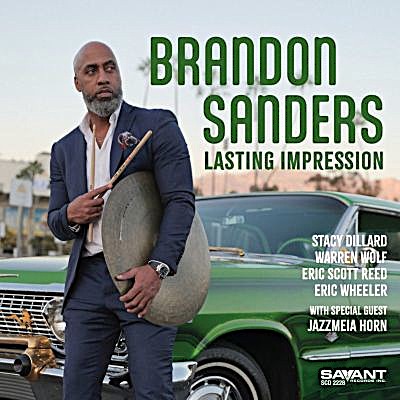
Drummer Brandon Sanders has followed his passion for jazz throughout his life. However, several detours diverted him from his growing recognition as a jazz drummer. Despite his initial indecisiveness, his friends—who recognized Sanders’s perseverance, dedication, generosity, and talent—encouraged him to record his first album, Compton’s Finest, at the age of 52.
Sanders’s passion for music grew from the time he was born. His mother played the violin, his stepfather played the trombone, and jazz was always playing in his home. His grandmother owned a Kansas City jazz club, Casablanca, where the jazz icons like Lou Donaldson and Grant Green performed. Sanders heard their music—and met them—when he was younger. Taking a cue from his stepfather’s collection of jazz albums, Sanders now owns over 30,000 albums of his own.
Sanders moved with his mother to Los Angeles before he was two years old. Music infused his soul even at that age. Even though he continued to visit his grandmother and hang out at her nightclub, Sanders channeled his percussiveness and soulfulness by deejaying and beatboxing in Compton. At the same time, he volunteered to assist as a social worker at the neighborhood’s Boys and Girls Club.
The commonality? Sanders found that music and social work furthered his sincere desire to help people feel better.
Even after graduating from high school, Sanders hadn’t started to develop his musicianship. Once again, his grandmother, Ernestine Parker, influenced him by enrolling him in the University of Kansas, where he was a walk-on basketball player. Sanders graduated with a degree in communications, but KANU jazz radio host Dick Wright intensified Sanders’s interest in jazz.
Studying with Wright led to Sanders’s decision—at the age of 25—to learn to play drums at a local church. Kansas City drummer Todd Strait—who also mentored jazz pianist Eldar and who continues to perform with Karrin Allyson—recognized Sanders’s talent and provided formal instruction.
Within two years, Sanders enrolled in Berklee College of Music, where he performed with outstanding musicians like Kendrick Scott, Joe Lovano, and his close friend Warren Wolf (who has performed on all Sanders’s albums).
Sanders’s final move was to New York in 2004, where Lewis Nash offered to let him stay in his apartment as Sanders adjusted to the jazz scene there. The adjustment was steady and fast, as Sanders accompanied jazz musicians like Lovano, Jeremy Pelt, Mike LeDonne, Jon Batiste, Peter Bernstein, esperanza spalding, and Walter Smith III. Yet another believer in Sanders’s talent, fellow drummer Willie Jones III, assisted by producing all three of Sanders’s albums, including his most recent one, Lasting Impression.
Sanders has achieved his lifelong goal of lifting the spirits of other people in two ways: by creating music that makes people feel good; and by working as a mental health counselor (as well as the tennis coach and the basketball coach) at The Masters School in Dobbs Ferry, New York.
Listening to Lasting Impression leaves a lasting impression about Sanders’s generosity.
The first track, Bobby Hutcherson’s surging “8/4 Beat” (123-123-12), features not only Wolf’s rhythmic talent within the tricky meter and the engaging anticipation of the beat, but also his exceptional improvisational work when the meter changes to a fast-paced 4/4. From Hutcherson’s 1968 Stick-Up! album with Joe Henderson, McCoy Tyner, Herbie Lewis, and Billy Higgins, “8/4 Beat” also includes on Lasting Impression brief solos from the other musicians comprising Sanders’s most recent quintet: powerhouse saxophonist Stacy Dillard, veteran pianist Eric Scott Reed, and in-demand bassist Eric Wheeler. Not to mention Sanders’s own minute-long solo over the piano and bass’s repeated vamp on “8/4 Beat.”
Sanders provided Reed with the opportunity to record two of his compositions, “Shadoboxing” and “No BS for B.S.” Framed by Wheeler’s resonant bass lines, at first as half notes under Reed’s single melodic notes that blossom into the three final fully chorded measures—“Shadoboxing’s” saunter switches to walking quarter notes once Reed improvises. Then, at 3:56, Wheeler emerges with his own solo interpretation of the piece, Sander’s generosity extending to both musicians as he holds back. Similarly, Wheeler’s vamp provides the initial pulse for “No BS for B.S.,” a swinging composition of twisting melodic lines resolving into sustained accents.
The leisurely pace of Mal Waldron’s beautiful standard, “Soul Eyes,” provides a showcase for Dillard’s version, who plays it in the tenor sax’s lower register to investigate the song’s burnished film noir-like darker colors. Reed delivers an exquisite solo of harmonic tranquility. But again, “Soul Eyes” is not a song lending itself to rhythmic complexity or vigor; Sanders generously included the track to focus attention on the other musicians.
Sanders brought back Jazzmeia Horn to sing two of the tracks on Lasting Impression. As she did on his Compton’s Finest, Horn sings a pop song and a jazz standard. The jazz standard on Lasting Impression: “Our Love Is Here to Stay.” The Stevie Wonder-written song is “Until You Come Back to Me,” a million-selling Aretha Franklin single in 1973. Consistent with Sanders’s goal to leave a lasting impression on his listeners, Horn sings the song with heart and soul.
But also, Sanders provided a recording opportunity for bassist Ameen Saleem (who played with Roy Hargrove, Sullivan Fortner, and Kenny Garrett) and rising talent Tyler Bullock (who just received The Gilmore’s 2026 Bell Young Artist Award after graduating from Juilliard earlier in 2025). Just as many others believed in Sanders when he decided to become a professional drummer, he is paying forward by continuing to help young musicians.
And by contributing to the success of young students with his social work.
Sanders’s blues composition on the album, entitled “Lasting Impression,” describes the result that he wants listeners to gain from his music. As he says, “Even people that ordinarily don’t listen to jazz, they feel it.” The projection of joy that remains with his listeners is by design.
And so is the heartfelt impression that Sanders leaves as he pays forward.
Artist’s Web Site: https://brandonsandersmusic.com/
Label’s Web Site: www.jazzdepot.com