








By now, Zev Feldman has established a well-deserved reputation as this generation’s leading producer of archival jazz recordings. Feldman’s ear for recorded jazz treasures—and the respect he has earned from owners of the original tapes of jazz legends’ heretofore unknown performances—have provided a cornucopia of awaited albums. If the recordings had been released in the year of—or even in the decade of—their performances, today’s jazz enthusiasts would have already included them as significant recordings in these jazz masters’ discographies.
Fortunately, these albums now exist to enlarge those discographies.
Elemental Music has released Feldman’s latest findings. All of them highlight the important contributions by three inventive, individualistic, and influential pianists, who long ago attained the status of jazz icons.
Shrewdly, Feldman’s choices of pianists for Elemental Music’s simultaneous releases—Michel Petrucciani, Bill Evans, and Cecil Taylor—couldn’t have been more different.
Or more alike.
More different because these pianists cover a broad stylistic spectrum.
That’s putting it mildly! They cover spectral extremes.
Not only do Petrucciani, Evans, and Taylor showcase the expansive artistic possibilities of jazz piano. They also illuminate the infinitely stirring expressiveness of the piano itself, which entrances audiences in many other genres as it combines melodic sentiment, harmonic richness, and percussive rhythms.
More alike because all these three jazz masters lose themselves in the spirit of their music, playing from the heart with artistic intensities that audiences perceive.
Their inspirations derived from the blues tradition that evolved into jazz (Evans, through his personal refinement of Nat Cole’s style; Petrucciani and Taylor, through their expansions of Duke Ellington’s colors). All three borrowed from European movements in large or small parts, though, of course, Petrucciani’s musical journey was the reverse of Evans’s and Taylor’s. He first heard Ellington on the TV in his home in Montélimar, France.
Although Petrucciani’s physical condition is much discussed—for it does distinguish him as a unique jazz artist—he remains a singular jazz influence because of his precise articulation, his sincerity of expression, his energetic improvisations, his harmonic originality, and the boundlessness of his imagination.
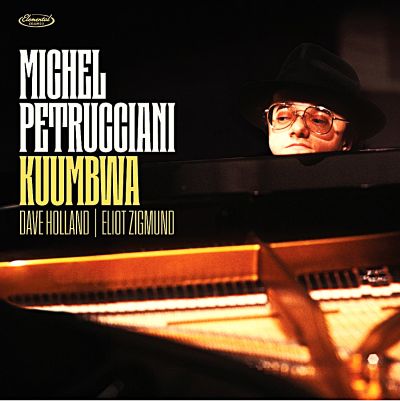
Kuumbwa—Elemental Music’s recent release of a Petrucciani performance at the Kuumbwa Jazz Center in Santa Cruz, California—allows yet another opportunity to appreciate the richness of Petrucciani’s music. Furthermore, Kuumbwa can help to elevate interest in Petrucciani’s recordings, thanks to the resourcefulness of Feldman and the far-sightedness of Kuumbwa co-founder Tim Jackson, who kept the tapes of this concert for thirty years.
Kuumbwa does distinguish Petrucciani as an intrepid prodigy. At the age of 24, he had already received recognition as a major voice on the jazz piano before he performed this recorded session in Santa Cruz in 1987 with bassist Dave Holland and drummer Eliot Zigmund. Blue Note Records had already signed Petruccini before releasing his first album, Pianism. Ambitious and visionary, Petrucciani had confidently moved from France to the United States at the age of eighteen. Then, he took the initiative to show up in Big Sur, California, to perform with saxophonist Charles Lloyd, thereby bringing Lloyd out of his ten-year sabbatical.
The twelve tracks included in Kuumbwa highlight the breadth and imaginative fecundity of Petrucciani’s talent. His immersions into his performances are evident even to listeners 39 years later.
For example, the spiritual element that Petrucciani absorbed from Lloyd rises from the meditativeness of “The Prayer,” a slow and gorgeous piece that contrasts with the vigor of some of his other tracks. The subdued nature of this, his own composition, allows for the appreciation of Holland’s feel for Petrucciani’s mood, including his note choices and his extended melodic bass solo. The song’s appeal supports Petrucciani’s statement, quoted by his friend and journalist Thierry Pérémarti in the package’s booklet, that “I believe in beautiful things.”
The next track, “Autumn Leaves”—originally the French song “Les Feuilles mortes” [“the dead leaves”]—evolves not slowly, as do Miles Davis’s and many other versions, but first as a scamper delivered by Holland’s astounding bass solo.
And evolve it does.
For Petrucciani supercharges the speed and the excitement with a joyful version. Consecutive, non-repetitive improvisational ideas reinforce the originality of his improvisation. Instead of flagging, Petrucciani’s energy surges. The evolution of the song rises to another level when drummer Eliot Zigmund—who reminisces in the booklet about his experiences with Petrucciani—takes his own solo.
The trio’s thrilling version of Lloyd’s “Sweet Georgia Bright” demonstrates Petrucciani’s stylistic contrasts.
And “thrilling,” without hyperbole, is the descriptively appropriate adjective for this performance.
Petrucciani’s deceptive introduction, a quick scurrying rubato solo, moves into the signature accents of Lloyd’s adaptation of the standard before the breathtaking improvisations over the changes to “Sweet Georgia Brown.” Playing at a prestissimo tempo, the trio’s piece left the audience with a memorable finale, the trio locked in during its only recorded performance at this concert. Petrucciani dynamically sweeps over the keys and rat-a-tats single notes with remarkable attacks, as if the trio’s initial controlled burn gradually ascended throughout the entire concert into a wild conflagration.
Another world-renowned jazz pianist, Enrico Pieranunzi, perceptively summarizes the differences between Petrucciani and Evans. In the booklet included with the album Kuumbwa, Pieranunzi observes: “[Petrucciani’s] music constantly absorbed new influences and moved through different phases…. The essence of [Evans’s] musical voice was already present in his earliest recordings. Michel, on the other hand, underwent a series of clear and fascination transformations.”
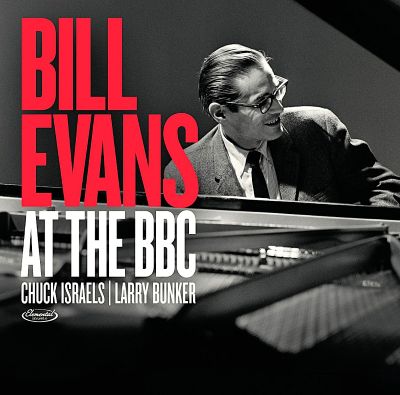
The differences among the pianists are immediately apparent when listening to Bill Evans’s album, At the BBC, his second trio’s 1965 recording. The album consists of two half-hour sets on the British TV show, Jazz 625, in BBC’s studios. Even though segments of that program’s video recordings have been available on LaserDisc, DVD, and YouTube, At the BBC, Feldman’s fifteenth release of Evans’s archival recordings, marks the first time that this trio’s Jazz 625 music is available on vinyl. The purity of the audio format, shorn of video’s distractions, concentrates on the essence of the music itself.
British musician Humphrey Lyttleton introduces each set with laudatory appreciations after the trio starts with Evans’s “Five” theme. Evans begins both sets with waltzes—”Elsa” for the first one and “How My Heart Sings” for the second. Bassist Chuck Israels, proud still of this major performance, recalls that “we were damn near perfect at the BBC.”
Indeed, after Evans states the song’s melody with a buoyant sway, Israels takes over with a creative solo to reinforce the mood of “How My Heart Sings” as Evans comps behind him. Evans returns to solo with brightly spirited joyfulness—and of course his flawless articulation—as if in fact the trio’s hearts were singing.
Israels’s essay and comments provide valuable insights into that trio’s interactions and experiences. He mentions the loss of the trio’s first bassist, Scott LaFaro, and his striving to provide a similar level of interactivity with Evans: “Scotty was far more developed as a musician and more confident than I was.” Humble and reserved though Israels may have been, he undoubtedly was prepared to play with one of the greatest jazz piano players. On Evans’s “Re: Person I Knew,” Israels and drummer Larry Bunker immediately support Evans’s changes of tempo and mood. And then, Israels takes over with, yes, confidence, as he takes the cue from Evans’s rising fifths in the treble clef to develop a resonant solo of melodic invention.
The album’s booklet is chock full of Israels’s insights—too many to list here. For example, in the paragraph that refers to “My Foolish Heart,” he states that the music is “about the dramatic arc of how what we played moved against the melody.” Or: “Spontaneity is at least partly an illusion. Passion and technique: Both are necessary to pull it off.”
Though perhaps intimidated by Evans’s famous first trio, Bunker as well was an excellent choice to carry on the tradition. Bunker’s light, pulsating brushwork on “Nardis” helps establish Evans’s flowing version, swinging and yet floating. When it’s Bunker’s turn to solo, he chooses sticks instead as Evans comps, Bunker avoiding flashiness as his volume remains consistent with that of the beginning and the end of the piece.
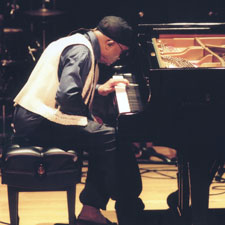
The passions of Bill Evans were internal, as this introspective pianist wrestled in solitary circumstances with his thoughts that he transformed into music. However, the third pianist of Elemental Music’s simultaneous releases, Cecil Taylor, shared with audiences his restless passions by communicating vividly from the piano his infinitude of ideas, compressed and exclaimed.
Try as one might, Taylor’s extroverted ferocity could not be denied. And besides, why would anyone want to resist his rapturous musical force, instead of sitting back and absorbing it?
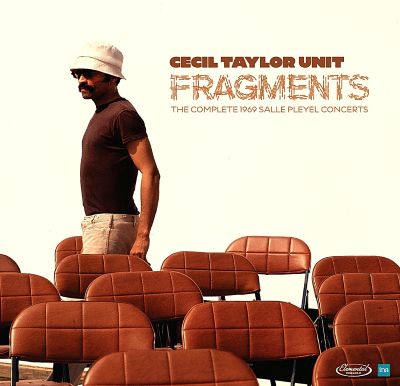
Once again, Feldman performed his magic to obtain tapes from L’Institut national de l’audiovisuel (INA) of a classic performance of the Cecil Taylor Unit. As part of George Wein’s 1969 Newport Jazz Festival tour of Europe, which included the Duke Ellington Orchestra and the Miles Davis Quintet, Taylor’s quartet played two sets, one in the afternoon and one in the evening, in the renowned Salle Pleyel Performing Arts Center in Paris.
Even though there have been video segments of the concert, the release of Fragments: The Complete 1969 Salle Pleyel Concerts presents the first album of the entire 2-1/2 hours of concerts during that single day.
Earlier that year, saxophonist Sam Rivers replaced Alan Silva in the Unit. Taylor’s partnership with under-recognized saxophonist Jimmy Lyons, which started in 1961, shaped the progress of the Unit, as both, of a single mind, shared ideas and practiced constantly. Drummer Andrew Cyrille had already worked with Taylor since they were teenagers in the 1950’s. As Cyrille recalls for Feldman’s interview in the Fragments booklet, “He listened to me, and I listened to him…. It was like a [pleasant] conversation.” Rivers fit in after rehearsing “four, five, six, seven hours without stopping. It gets to be like total creativity.”
So, the Unit consisted of musicians with telepathic mutual understandings.
And the result of their concert at Salle Pleyel was uncompromising creativity, sprung from bold spontaneity made possible by the driven commit to their art.
Taylor’s Unit put to the test Duke Ellington’s quote: “You have to stop listening in categories. The music is either good or it’s bad.” Taylor’s music certainly is “beyond category.”
The irony is that two musicians influenced by Ellington were on the same tour: Taylor and Davis. Yet, when they were on the same stage, Davis told his band members, “Don’t listen to him” because Taylor and Davis thought and performed on two different planes.
The fact that jazz can contain sharply divergent approaches to music attests to the breadth of its scope.
Taylor’s dedication to Ellington at Salle Pleyel demonstrated his close listening and appreciation of Ellington’s music as he elaborated, in his own dynamic way, upon various favorite passages.
Fragments commences with the Taylor Unit’s shorter (at almost fifty minutes) evening performance. The contrast between the French host’s polite and seriously respectful introduction—under which Taylor softly plays alternating second-treble-octave spare teasing chords—and the free-jazz might at 1:16, when the entire quartet joins in, couldn’t be more startling. The tempest breezes through peaks and valleys, uninterrupted and unapologetically honest, stirred by the development of the other three musicians’ thoughts from the fourth’s ideas by means of thrilling give-and-takes. The responsiveness and creativity of Rivers within an established group of musicians attest to his compatibility and his commitment. At 11:35, the saxophones briefly drop out to allow Taylor to express freely with swirls, tornadic upsweeps, and scampers over Cyrille’s thunderous, empathetic accompaniment. The storm of Taylor and Cyrille, unsurprisingly indefatigable, continues for 18 minutes. After that, Lyons and Rivers emerge with subtly increasing volume to conclude the set with increasing vitality, which mirrors the beginning.
The 92-minute afternoon set, so long that it was divided onto two CD’s, created the atmosphere for the evening performance. That afternoon performance starts too with a medium-volume theme that quickly evolves into an agitated, instantaneous musical discussion. Its intensity rises into a prolonged abstraction of irresistible energization. In addition to his musicianship, inventiveness, and brave pushing of the envelope, one has to admire the startling exuberance that Taylor and his Unit’s musicians shared. Their expansion of the definition of jazz influenced future generations of musicians. Pianist Matthew Shipp comments in his essay for the album that Taylor “was a real artist. …He embodied jazz history, but he also embodied the ideas of originality and freedom. He was fearless.”
By releasing these three important albums of legendary jazz pianists, Elemental Music and Zev Feldman have done more than thankfully making available sterling performances previously unavailable in their entirety in audio formats.
Taken together, all three albums represent a musical essay about the multifarious elements within the human spirit that make possible the creation of art.
Label’s Web Site: www.elemental-music.com