





There’s never enough of Kenny Barron’s music.
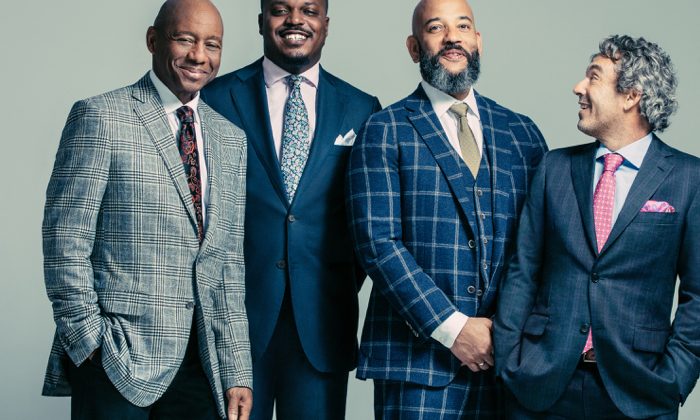
One set wasn’t enough for me. Earlier this year, I luxuriated in two consecutive sets performed by his trio consisting of recently deceased bassist Kiyoshi Kitagawa and drummer Johnathan Blake. Despite the bleak winter weather, the event sold out.
Barron always leaves listeners wanting more. One reason may be that he sizes up his audience. Before the trio started playing, Barron, genial and succinct, observed that “we have some older people in the audience tonight. They may remember this song.” So, he started the concert with “Canadian Sunset,” perhaps as a tribute to jazz pianist Eddie Heywood, Jr. (whose recording of his composition was a hit in 1956, as was his recording of “Begin the Beguine” in 1944).
The insatiable desire for more music from jazz legends may explain archivist Zev Feldman’s ever-advancing quest to produce new albums of previously unreleased performances.
Feldman’s mutually beneficial relationship with Elemental Music’s founder and president, Jordi Soley, led to his introduction to Barcelona’s legendary jazz producer, Jordi Suñol. Possessing a treasure chest of nearly one thousand taped jazz performances in European venues over the past forty years, Suñol is in the process of releasing them commercially.
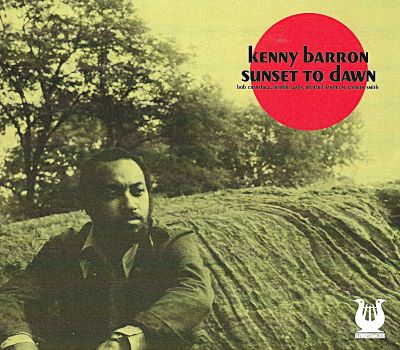
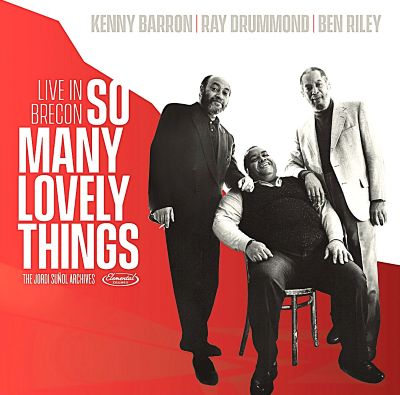
For the first time, Brecon Jazz Festival director Jed Williams’s taped recording of the Barron trio’s 1995 performance is available as Live in Brecon: So Many Lovely Things. Barron’s album marks Suñol’s eighth archival release so far—and the first on the Elemental Music label.
Not only does So Many Lovely Things immediately attain importance as one of the few recordings led by Barron in a concert atmosphere. But also, it provides additional music by his superb regular trio with bassist Ray Drummond and drummer Ben Riley.
As always, Barron performs with eloquence, imaginative improvisational choruses, and fluid though precise articulation, as inspired by his early exposure to the music of Tommy Flanagan and Hank Jones, both of whose playing, Barron says, “really tell a story. They play their lines like speaking sentences.” In addition, Barron has performed in duos co-led by like minds such as Charlie Haden, Mulgrew Miller, and Ron Carter or in established groups like Dizzy Gillespie’s, Stan Getz’s, Yusef Lateef’s, or Freddie Hubbard’s. And then there are Barron’s exquisite accompaniments behind vocalists, as in his recent Songbook album.
Spoken like a consummate accompanist who boldly goes where no one has gone before, Barron states that “I don’t want to be put in any kind of pigeonhole, although I’m sure I am. Different situations force me to play other things. …You’ve got to reach.”
Fearlessness with grace defines Barron.
Fearlessness with grace is what the audience in Brecon, Wales heard on August 12, 1995. Fearlessness with grace is what I heard in 2026. Barron’s remarkable artistic consistency throughout those 31 years and beyond confirms that he is one of the giants of jazz with a recognizable style all his own. As Drummond said, “Kenny will attack any piano and make it sound like Kenny Barron, even in this era of modern recording, where so many people sound so much alike.”
In both concerts, Barron projected fearlessness when he played with elan solo versions of Thelonious Monk’s “Shuffle Boil.” Barron’s statement in the liner notes could be his musical vision statement: “Let’s see where it goes.” “Shuffle Boil” may be borrowed from Barron’s fearless interpretations of Monk compositions in Sphere, a quartet in the 1980’s with Monk’s saxophonist and drummer, Charlie Rouse and Ben Riley. In the 1990’s, after Rouse’s passing, Sphere regrouped with saxophonist Gary Bartz. Barron tackled “Shuffle Boil” as an exhilarating solo, defying the expectations of an audience that may have expected ballads and post-bop standards. Though Barron introduced “Shuffle Boil” as a “very short piece,” he extends it for 6-1/2 minutes. Thankfully, it wasn’t “very short,” though, of course, Barron did leave the audience wanting more. Combining a stride rhythm and signature Monk phrases, harmonies, arpeggios, and dissonances, Barron exhilarated both audiences with tours de force.
In both concerts, Barron projected grace, for, yes, he performed “Canadian Sunset” at the Brecon Jazz Festival too, its extended vamp used as a cue to calm the applause from the previous piece, “The Very Thought of You.” But unlike so many other versions that repeat Heywood’s version, Barron made the song his own with brightly spirited interpretations of sustained notes ringing like bells, intriguing re-harmonizations, teasing rests, dynamic contrasts, and rhythmic changes emphasized by Riley’s locked-in support and resonant walking bass lines.
The Brecon concert, consisting of 95 minutes on two CD’s or two LP’s, continued as one of contrasts. There were fearless immersions into undaunted “reaching” such as Barron’s fast-paced, galloping version of “The Surrey with the Fringe on Top,” which had already been recorded by Ahmad Jamal, Miles Davis, and Sonny Rollins. Particularly evident throughout the trio’s version is their immediate support, as of one mind, when Barron switches moods by delivering spontaneous improvisational ideas such as a treble line of tremolos supported by darting single bass notes, or breathtaking arpeggios, or the dynamic tension of a stretched build-up.
As a characteristic of many of his other performances—such as “Twilight Song” on Night and the City and Live at Bradley’s II: The Perfect Set; or “Cook’s Bay” on Spirit Song, Book of Intuition, and Songbook–Barron treated his Welsh audience to some of his own compositions that “really tell a story.”
Even the title of his “Silent Rain” track is evocative. (Why is the rain silent? Is it viewed through a window? Is it drizzling? Is it a photographic image?) So, Barron takes a visual idea and, through his solo textures, paints an expressive musical description—not one that’s abstract, but rather one with sweeping brushstrokes of arpeggios contrasting with meditative pauses of shimmering harmonic resolutions.
And then, “Nikara’s Song,” dedicated to Barron’s granddaughter who was six in 1995, seems to tell the story, not only of her actions or appearance, but also of his own feelings. Barron introduces the piece at his leisure with a two-minute exploration of the ballad’s voicings that emerge from typical Barronian exquisiteness—a reminder of his affinity for Flanagan’s and Jones’s respect for the lyrical basis for songs. Drummond continues the affect of “Nikara’s Song” with a long melodic, thoughtful solo of his own.
Barron pays tribute to Hubbard with a slightly re-harmonized version of “Up Jumped Spring,” whose alternating moods and rhythms alternate from walking bass lines to an implied swing that eventually becomes audible. Barron puts his own stamp on “Time Was” from the 1957 album with Red Garland, Coltrane, when, at 5:10, Barron breaks into his improvisation of signature rapidity before Drummond and Riley trade eights and then fours.
How fortunate it was to have experienced a Kenny Barron live concert!
However, the fastidious attention to sound quality inherent in all of Feldman’s projects provides that experience on Live in Brecon: So Many Lovely Things.
Just as if 1995 were 2026.
Artist’s Web Site: www.kennybarron.com
Label’s Web Site: www.elemental-music.com