







Perhaps because she hasn’t been a part of a single jazz community throughout her career of over fifty years, Sumi Tonooka hasn’t achieved due recognition for her significantly original contributions in advancing jazz. However, her recent projects should help expand the awareness that she deserves, particularly those with the Alchemy Sound Project.
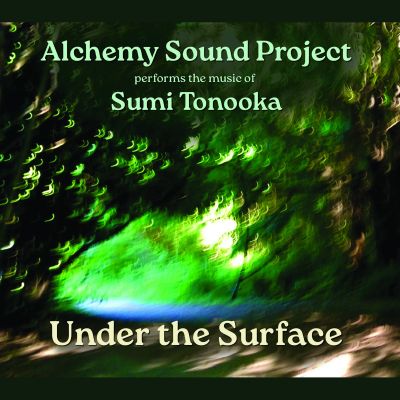
The Alchemy Sound Project’s most recent album captures the distinctiveness of Tonooka’s signature style and the omnipresence of thematic foundations that enliven her music.
That album, Under the Surface, declares on the cover that the jazz collective “performs the music of Sumi Tonooka.”
Her music suggests the intensity of some of her experiences, for both good and ill. In addition, her compositions express through art some of her beliefs that were sharpened when, abruptly, COVID disrupted worldwide communities. With funding provided by Chamber Music America’s New Jazz Works program, Tonooka started writing her Under the Surface suite at the start of the horrifying pandemic in 2020.
The fact that Tonooka composed all seven tracks occurs because Under the Surface is more than seven separate compositions arising from seven separate ideas.
One prevailing idea infuses Under the Surface. Its individual tracks are movements of expanding details that branch out from her encompassing subject.
Tonooka’s prodigious work in jazz groups, film scoring, solo recitals, and symphonic orchestrations often has involved writing music about specific topics. Blending jazz with Asian and Western classical music, From the Silence pays tribute through spoken word and music to her mother of Japanese ancestry, Emi—who was forced during World War II to leave her home on Bainbridge Island in Washington state for the Manzanar concentration camp. Tonooka’s concerto for orchestra and jazz trio, For Malala, honors Pakistani activist, Malala Yousafzai. And she wrote additional music for Mary Lou Williams: The Lady Who Swings The Band, a film about the legendary jazz pianist with whom teen-aged Tonooka studied.
Having appreciated Philadelphia’s sense of community after her reunited family moved there—as well as the mutual support within the larger jazz community, as exemplified by the Alchemy Sound Project, not to mention the Emerging Black Composers Project and the Asia Society—Tonooka observed the flora’s nourishing intertwined root systems as a metaphor for the flourishing made possible by human beings’ mutual support.
And that’s what Under the Surface is all about—the heightened majesty of living communities, whether forest, foliage, fauna, or human, made possible by interrelated sustenance. The theme of mutual support is a culmination of Tonooka’s events and observations throughout her life.
Tonooka’s suite starts thrillingly with acclaimed drummer Johnathan Blake’s rousing minute-long solo. Even Blake’s participation in this project results from the benefits of communal spirit. Tonooka knew him when he was a child, for she performed for over 30 years with Johnathan’s father, jazz violinist John Blake.
On that title track, “Points of Departure,” Tonooka reveals her connective theme, a jaunty modal pattern that evolves into variations over the complex rhythm provided by Blake and bassist Gregg August. The album’s introduction of just the three of them on the first track allows appreciation of its musicians’ individualistic talents, establishing a unique piano trio sound of its own. Their unspoken affinity enables the accomplishment of Tonooka’s vision as they instantaneously respond to the directions in which her performances move. A true improviser, Tonooka says, “There’s no chart in terms of the chords. We play a theme and just start to go.”
The approach taken during “Points of Departure” suggests that Under the Surface will be a piano trio album.
Not so.
“Points of Departure’s” winding melodic pattern and August’s complex bass lines give no suggestion of what’s to follow on the next track, “Savour.” Trombonist Michael Ventoso’s initial plunger-muted trombone solo of wah-wah’s, dynamic swells and contractions, and vocal simulations announces the expansion of Tonooka’s group. Her octet’s intimations of orchestral swing contain unmistakable Ellingtonian references. Eventually, the piece evolves into a two-minute virtuoso solo by tenor saxophonist Erica Lindsay, accompanied solely by Blake for the second half of its length. Their enjoyment in the musical give and take can be perceived by the listener (as, for example, when Blake imitates Lindsay’s final trill as the segue to a drum solo).
Tonooka based her intriguing “Interval Haiku”—the album’s longest track at almost eleven minutes, and its most majestic—melodically on intervallic leaps and structurally on haiku’s 17-syllable rhythm. This isn’t the first time that Tonooka referred to haiku’s form, originated in Japan, the country of her ancestral roots. Her orchestral work, Only the Midnight Sky and Silent Stars, was inspired partly by Philadelphia native Sonia Sanchez’s poem, “Haiku and Tanka for Harriet Tubman.” Tonooka blended all the creative elements to compose a work of several sections. The first is a haunting minor-key blend of layered long-tone hues recalling some of Gil Evans’s works. After a little more than a minute, Tonooka establishes the jagged theme, somewhat reminiscent of Thelonious Monk, whose distinctive style of combining humor and thorough originality inspired her when she heard him at the age of 13. Tonooka’s four-minute solo is the first of several—including August’s, trumpeter Samantha Boshnack’s, and tenor saxophonist Salim Washington’s—before the conclusion that bookends the piece with again the horns’ warm sonic colors (and Tonooka’s final Monkish upper-treble accents).
On “Tear Bright,” Tonooka reflects upon the tragedies of the dark times of the COVID pandemic with the beauty of her coruscating piano solo, Ventoso’s serene improvisation, and the tonal exquisiteness of Washington’s interpretation on bass clarinet. “Mother Tongue” succeeds because of Blake’s empathetic rhythms and because of the dynamism and texturing that his drumming adds. Once again, the instantaneous exchanges between Blake and Lindsay are remarkable on their own. But then Boshnack also contributes an electrifying solo to augment the piece’s excellence.
With solely a bass accompaniment, “For Stanley” musically recollects the influence of jazz pianist Stanley Cowell upon Tonooka’s artistic growth when he mentored her early in her career. Thoughtful as ever, she composed the piece—more relaxed in 12/8 than the others on Under the Surface—with contrasts between light and shade to recall his brilliance dimmed by his passing at the time she was writing this suite.
The track of “Under the Surface,” which concludes the album, establishes a modal element upon which the members of Tonooka’s octet can improvise. Her signature dissonances and changes of meter and signature phrases blend to create a compelling statement about the important accomplishments that community actions can achieve…
…and to remind listeners of the important contributions of Sumi Tonooka.
Artist’s Web Site: www.sumitonooka.com
Label’s Web Site: www.alchemysoundproject.com