




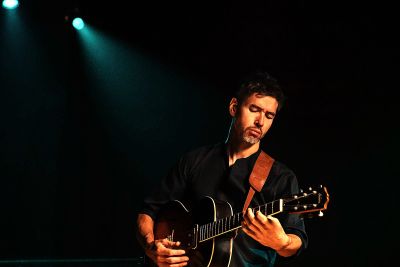
That’s right. As the heading states, Miles Okazaki played from memory all 66 of Thelonious Monk’s compositions at The Jazz Gallery on Broadway and 27th Street in New York.
Without accompaniment.
After two years of work and planning.
The responsibility for preparing and performing such an event was entirely Okazaki’s.
After hearing the guitarist play Monk’s music at SFJAZZ, David Breskin—a producer similarly inspired by Monk to the extent of naming his son Thelonious—challenged Okazaki with the intimidating idea of a film that documents his performance of Monk’s entire repertoire.
Without written music. Entirely from memory.
In one evening.
Having never before considered accomplishing such a immense task, Okazaki hesitated before accepting the challenge.
Breskin must have known that he chose the right musician for the event. Previously, Okazaki had recorded Work: Volumes 1-6, a stunning six-album package of all of Monk’s works recorded over time in the more leisurely environment of his apartment.
Ever analytical, methodical, and creative, Okazaki developed a plan and a timeline for completing the quest.
The performance would be called The Monkathon!
Which also is the name that Breskin applied to the resulting video.
With only three breaks, Okazaki played all 66 songs alone before a sold-out audience for more than five hours of music.
Why do it?
Okazaki’s first transcription was “’Round Midnight,” which, by using a harmonica for pitch, he wrote during a road trip with his father. Okazaki, forever fascinated with the complexity and simplicity and approachability of Monk’s music, compares performing the entirely of Monk’s music to the appreciation of a work of art. “It’s about getting your mind around his whole body of work. If you’re ten feet away from Notre Dame Cathedral, you just see some surface. You have to get back and see the whole structure to see how one thing relates to another.”
Combining intellect with his lifelong passionate commitment to Monk’s music, Okazaki filled an entire notebook with transcriptions and prompts about his performances.
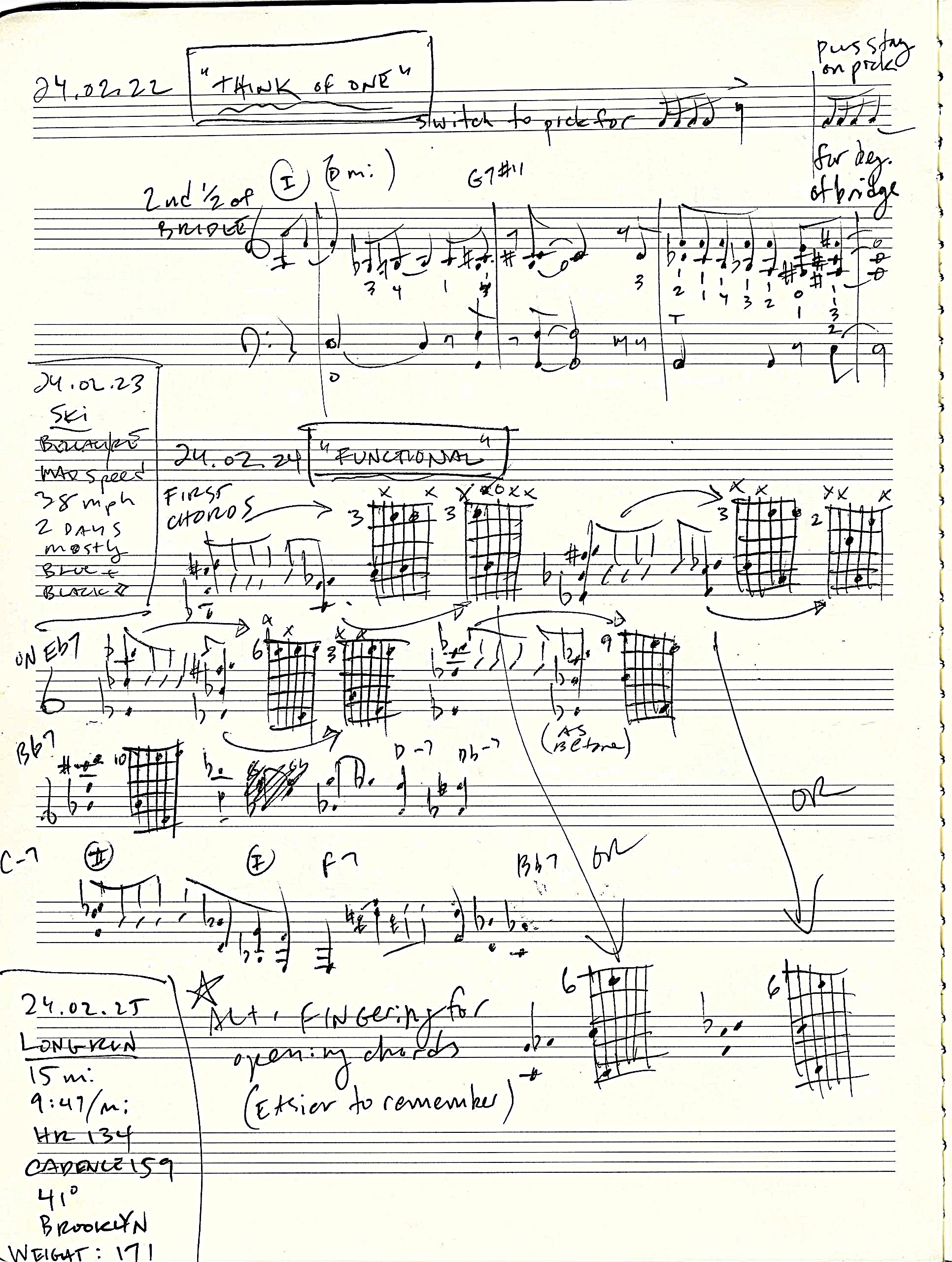
Those two unparalleled performances encompassed Okazaki’s intense interpretation of Monk’s music for guitar; notes about stylistic and harmonic possibilities; decisions about the appropriate moods for the songs; shortening the lengths of the songs to fit them all in one evening; and even reminders to “look at the audience.”
At the same time, Okazaki, never one to allow down time, was preparing for the TCS New York City Marathon on November 3, which took place two weeks after The Monkathon’s dates of October 16 and 18. The crossover associated with the preparations for both events is evident in his Monk notebook. It includes running reminders, such as “24.03.11 Long Run 19 mi. difficult run 3 hrs. 3 miles,” possibly as he trained for the May 18 RBC Brooklyn Half Marathon.
So, the pressures of both autumn events, one artistic and the other athletic, seemed to have motivated Okazaki. He not only surmounted both challenges through analysis and training, but he also recognized their similarities in the “cadence” of running, as he calls it in one of his notes on the “Think of One” page.
Such dedication commenced when Okazaki, after much preparation, booked the evenings in 2024 at The Jazz Gallery and gave the green light to Breskin and film maker Frank Heath.
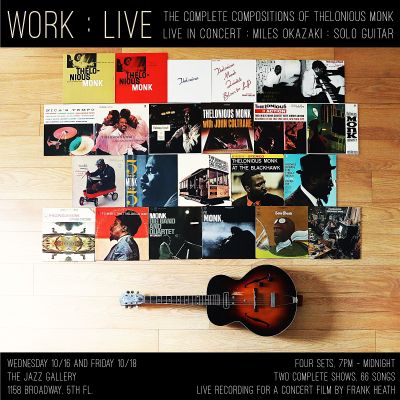
The fortunate result allows jazz enthusiasts around the world to appreciate The Monkathon because now the entire concert is available online at www.Monkathon.com.
In addition to the concert recording, Breskin and Heath documented in Okazaki’s own words his discovery of and his continuing understanding of Monk’s artistic contributions. The “Behind The Monkathon” video provides insights into Okazaki’s decisions about each song’s length, stylistic solutions, and alternative methods for individual phrases. “Behind the Monkathon” also provides a brief portrait of the artist as a young man, including Okazaki’s early written guitar studies.
But the achievement!
The online video documents the entire concert in four sets organized by what Okazaki often calls “chunks:” specific periods of Monk’s development and recordings. So, for example, Okazaki starts the concert with pieces from Monk’s albums, Genius of Modern Music: Volumes 1 and 2, such as “Skippy” and “Hornin’ In.” Correspondingly, the comments in his notebook provide insight about his performance of “Hornin’ In,” for example. The written notes remind him to “leave this out” or “use bass notes for ghosts instead of upper notes.”
Just this slight description for one composition within one set and then one composition indicates the enormity of Okazaki’s undertaking. Such analyses of Monk’s music and the abundant details incorporated into the concert—which was committed to memory—attest to the uniqueness of the event.
The title of Monk’s Genius of Modern Music albums was certainly prescient. Okazaki said that Monk’s music “still feels alive. His music was so advanced that nothing else came along and replaced it. People are still trying to understand it.”
Ironically, Okazaki concludes the concert with the same song that he first transcribed: “’Round Midnight.”
The release of The Monkathon provides insight into the processes that Miles Okazaki not only followed, but developed, to comprehend Thelonious Monk’s innovative artistry that will continue to “be alive.”
Artist’s web site: https://www.milesokazaki.com
Video’s web site: www.Monkathon.com