



There comes a time when a person leaps from preparation to accomplishment.
Modest despite his natural talent as a drummer, Brandon Sanders for years demurred from making the leap. He continued to accompany some of New York’s finest jazz musicians, such as Joe Lovano, Jon Batiste, and Walter Smith III.
But when his friend and informal advisor, vibist Warren Wolf, encouraged Sanders to record an album, he hesitated: “Man, I don’t think that I’m ready.” Fortunately, Sanders took Wolf’s advice: “The only way you’re going to be ready is to do it.”
Sanders did it.
At the age of 52, Brandon Sanders recorded his first album, Compton’s Finest, on his birth date of February 20, 2023.
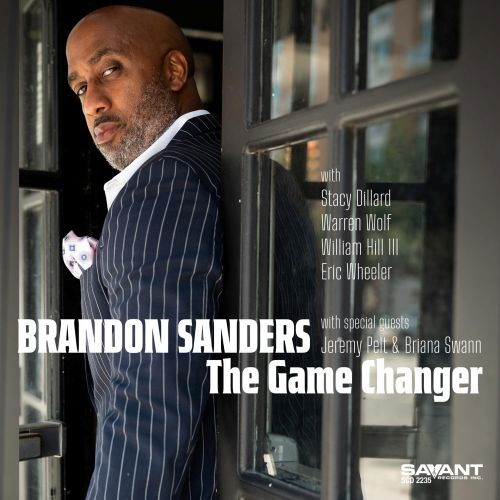
Having overcome his initial reluctance, Sanders has released an album in each of the following years, including, in 2026, The Game Changer, his fourth album.
The acceleration of recording activity resulted not only from the positive feedback of critics and jazz enthusiasts, but also from Sanders’s realization that music transfers his joy to listeners.
Sanders has said that “jazz has always had a kind of spiritual quality.” He explains, “I have a big heart, and when I play for people, it’s not about me. I want to lift people up.”
His big heart has reached out to others on a face-to-face basis too. Sanders has helped lift people up with his activities in social work. That interest started with his endeavors in the Compton neighborhood of Los Angeles, where he grew up. Later, it expanded when he enrolled in the Master’s program in social work at the University of Kansas.
Sanders’s university years in Kansas created other avenues of self-discovery. One was the teamwork he found as a member of the University of Kansas’s basketball team. The other was the study of drums that he started at the age of 25 through the encouragement of Kansas City drummer Todd Strait.
One thing led to another.
Sanders moved to Boston to study jazz at the Berklee College of Music, where he met lifelong friends Wolf, trumpeter Darren Barrett, and drummer Kendrick Scott. He immersed himself in the New York jazz scene when he moved there in 2004.
All the roads that Sanders has taken converge on his most recent album, The Game Changer. With an obvious reference to his experiences on the University of Kansas’s basketball team—and its allusion to the difference that a single person can make—The Game Changer suggests that each member of his band contributes invaluably to the success of its sound and to its acceptance from listeners.
Another notable contribution—though Sanders, with his “it’s-not-about-me” reticence, doesn’t emphasize the point—is his own compositional skills. He wrote half of the pieces on The Game Changer, thereby reinforcing his intention to lift people up with the cheer inherent in the music that has molded his life.
Appropriately, the album commences with Sanders’s own musical tribute to Art Blakey’s Jazz Messengers, “The Game Changer.” It grooves from the very first note. It was no coincidence that the track’s instrumentation includes a lead trumpeter (Jeremy Pelt) and a lead saxophonist (Stacy Dillard), as did the Jazz Messengers (along with an occasional trombonist, like Curtis Fuller; a percussionist, such as Ray Mantilla; or a guest musician). With swing and swagger, “The Game Changer’s” hard-bop joie de vivre takes its cue from some of Horace Silver’s, Hank Mobley’s, or Benny Golson’s works.
Comparable to his tributes on previous albums—such as “SJB” (on his Compton’s Finest album), which was dedicated to friend who pushed him to higher levels of achievement—Sanders wrote for The Game Changer two songs about relatives who helped elevate his life. “James Arthur,” a coolly strolling minor blues, recalls his stepfather, a trombone player who surrounded Sanders with the sound of music all day in their Los Angeles home. Also, Sanders includes a song about his mother, “Pamela the Queen,” who kept him engaged in positive pursuits throughout his childhood in Compton, such as participation in his neighborhood’s Boys and Girls Club. As on “James Arthur,” Wolf establishes the shifting colors of “Pamela the Queen,” though at a slower tempo and in a more reflective style. Pianist William Hill III and bassist Eric Wheeler expand upon “Pamela the Queen’s” glowing regality with respectful, melodic solos. Sanders the composer remains discretely in the background of “Pamela the Queen” as Sanders the drummer allows the other musicians in his quartet to convey the emotions of his musical remembrances.
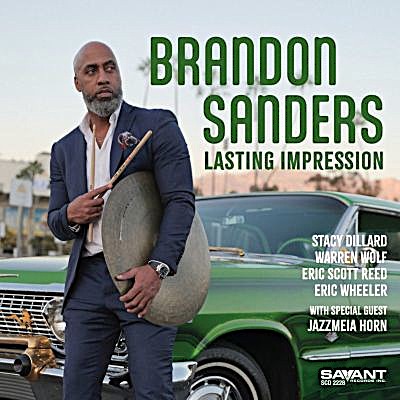
Sanders’s group expands to a quintet when Dillard reasserts the inimitable spirit that elevated the joy level of Lasting Impression, Sanders’s popular 2025 album. Dillard’s high-wire solo on Sanders’s exhilarating post-bop piece, “Shrimp and Grits” (which refers to a menu item at Row House Harlem, where Sanders occasionally performs), alternates between staggering the beat and breaking into a blizzard of notes throughout eight choruses. Throughout his solo, Dillard’s improvisational thoughts evolve without the slightest hint of repetition. In addition, Dillard pays tribute to Johnny Hodges on his own poignant version of “Isfahan,” each note seeming to have been delivered for a particular emotional effect.
A sextet delivers Sanders’s messages of heartfelt connections with listeners when trumpeter Jeremy Pelt joins the festivities. His own cleverly written piece, “S.M.B.,” with understated warmth, flows calmly through unconventional harmonic deviations from expectations. Pelt contributes to Sanders’s burnished portrait of “Sunsets in Santa Monica,” a relaxing samba. Pelt’s muted solo shifts the dimming hues over the shimmer of Wolf’s vibes. The kinship between Pelt and Dillard doesn’t go unnoticed as their harmonic lines weave the winding melody of “S.M.B.”
Sanders invited Briana Swann to sing during a gig at The Jazz Club, a reservations-only speakeasy off West 56th Street that she manages for Aman, a worldwide destinations company. An emerging talent, Swann’s background in gospel, R&B, and jazz has developed into a singular voice—one that reinforces Sanders’s eclecticism for music that moves the soul. Merging with the instrumentalists into a single musical presence, Swann sings Antônio Carlos Jobim’s “Quiet Nights of Quiet Stars” and the Isley Brothers’s “Footsteps in the Dark” with emotional immersion into the songs’ moods.
Sanders is grateful for the good fortune that arose when mentors pushed him to break through barriers of self-doubt so that he could ascend to higher levels of achievement.
Absolutely generous and compassionate, Sanders now strives for his music to be a game changer that inspires others to rise up too.
Artist’s Web Site: https://brandonsandersmusic.com/
Label’s Web Site: jazzdepot.com