









Music that endures projects the personalities of the musicians, their instruments evolving into extensions of their own beings, their music as expressive as a speaking voice. That singularity of artistry remains constant, as firmly in place as is the musician’s nature. Flows of notes rise to an ethereal level that captures spiritual characteristics, intellect and physical talents joined for a higher purpose. Who else sounds like Thelonious Monk, Dizzy Gillespie, Charlie Parker, John Coltrane, or Billie Holiday? They inspire through their originality and soulfulness.
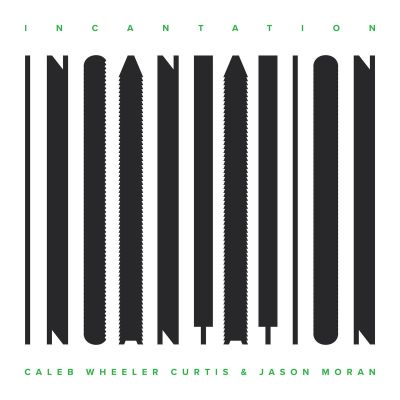
Caleb Wheeler Curtis and Jason Moran, two ground-breaking musicians with sounds of their own, have recorded a duo album that will endure: Incantation.
Honoring the jazz innovators of previous generations, the recording’s name reinforces the spiritual element of jazz. As Curtis says, “In a sense, this music is a call to the ancestors. It’s just impossible to play without invoking them.
Even though the invocation includes and expands upon the jazz icons’ personal contributions to the art form—their compositions, their energy, their phrases, their notes—remembrance don’t overwhelm Curtis and Moran. Rather, the influences of, for example, “Crepuscule with Nellie” or “A Love Supreme” are the DNA within Curtis and Moran’s music: essential elements for the fulfillment of their sound.
In addition to the spiritual basis for Incantation, Curtis and Moran’s collaboration contains at least six more elements: spontaneity, experimentation, atmosphere, narrative, elasticity of rhythm, instrumental textures, and tonal value. With remarkable like-mindedness, both achieve sonority that elevate their performances above mere notes.
Incantation’s most placid track demonstrates all the duo’s unique qualities. Moran’s “Restin’” commences forebodingly with broadly spaced single sustained bass notes, resonating commandingly as would a gong. In response, Curtis plays stretched-out treble notes, the musicians’ attention to tonal quality suggesting mysterious intimations of darkness, even as Moran plays a contrasting repeated note on the piano’s dampered string.
Moran adds to the playlist his composition that he had recorded on the Black Stars album with his Bandwagon trio and Sam Rivers: “Gangsterism on a River.” This time, Curtis plays the piece with delicacy and tonal purity as Moran accompanies with his pulsating rhythm and harmonic richness.
In addition, Moran speaks briefly about one of his mentors, Jaki Byard, before he and Curtis launch alto saxophonist Arthur Blythe’s piece, “Miss Nancy” from Blythe’s 1980 Illusions album. Curtis presents the melody and improvisation with dynamism and full immersion into the piece’s joyfulness, Moran memorializes Byard with a romping solo that recalls his predecessor’s humor, unpredictability, extraordinary technique, and borrowings from stride technique.
Regarding extraordinary technique, not to mention instantaneous spontaneity, the duo plays two improvised gems, “One Hundred Years” and “Archaeology.” Not only is the immediate exchange of ideas apparent, particularly at 2:23, when Moran nudges Curtis into a dizzying response with a coruscating spray of treble notes. Curtis also expands upon Moran’s change of mood when his rumbling bass-line improvisation on the piano leads to the culmination of a build-up of increasing volume. At 3:50, the strength of Moran’s chords support Curtis’s altissimo wail.
“Archaeology,” the other improvised track, is notable because Curtis plays it with an instrument that he has recently learned: the trumpet. Curtis’s sound and fury, and his imaginative approach to solos, remain intact, his diligent attention to tone, his smearing of notes, his ornamental turns, and his sonic clarity. After accompanying Curtis’s development of the ideas for the piece, at 2:39, Moran emerges with his solo improvisation of inimitable riotous vigor until Curtis rejoins, as if the two of them are in a musical conversation. Which they are. One of Moran’s inventive pieces is “Ringing My Phone (Straight Outta Istanbul)” from The Bandwagon: Live at the Village Vanguard, on which Moran plays the phrasing from a person’s spoken telephone conversation.
Curtis includes four of his own compositions: “That Which Cannot Be Replaced,” “Ain’t No Storm,” “Floatation Device and the Shivers”, and “Storm (Reprise).” The first track of the album, “That Which Cannot Be Replaced” piques the listener’s interest with the calmness and melodiousness of Curtis’s initial solo introduction. At :28, Moran comes in with spare harmonic sketches, almost fugue-like. But that doesn’t last long. The dialog of the two musicians intensifies at 2:28 with Curtis’s acceleration of tempo triggered by the whirlwind of a repetitive phrase. Moran develops a jingling treble-clef embellishment that immediately descends, at 3:18, into bass-clef thunder. And the initial gentleness of the introduction leads to fierce crashing contrast for the ending.
With fearlessness, creativity, and virtuosity, Curtis and Moran confirm that they are among the foremost jazz musicians of their generation.
Incantation is one of the best albums of 2026.
Artist’s Web Site: www.calebcurtis.com
Label’s Web Site: imanirecordsmusic.com
