




Have assumptions ever made you reluctant to ask a favor of someone you admire? Maybe you assumed that the person you hold in high regard was too busy to grant your request. Maybe you assumed that the person may politely decline.
Mark Sherman, jazz vibist/pianist extraordinaire, didn’t have to ask for the special favor that he had wished for.
Legendary bassist Ron Carter politely expressed an interest in recording with Sherman, his faculty colleague at the Juilliard School. Carter knew that Sherman had recorded with numerous respected jazz bassists during his career of 40-plus years. But Carter didn’t know why they, who worked in the same building, hadn’t recorded together.
Sherman has recorded prolifically since his first album, Fulcrum Point, was released in 1980. The frequency of his releases accelerated when he established in 1998 his own label, Miles High Records.
Carter, by far the most recorded jazz bassist, has recorded more than 2,200 albums, and his work with Miles Davis’s second quintet resulted in numerous classic recordings.
That Sherman was flattered by Carter’s idea would be an understatement.
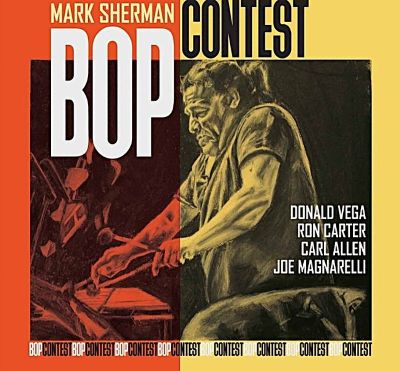
His hesitancy alleviated, Sherman went to work assembling three more musicians to record a new album, Bop Contest: pianist Donald Vega (a member of Carter’s Golden Striker Trio), drummer Carl Allen, and trumpeter/flugelhornist Joe Magnarelli.
Now, at the age of eighty-eight, Carter has added one more distinguished album to his massive discography.
And Sherman has led his twenty-second album.
But this one is different from the other twenty-one recordings. Bop Contest is Sherman’s first album that includes a bebop composition, despite recording multiple other jazz forms on hundreds of other tracks.
That composition is “Bop Contest,” whose name extends to that of the album, which was recorded at the legendary Van Gelder Recording Studios.
One would expect that there would be “no contest” because of the involvement of an undisputed master like Carter, or because the recording showcases mutual admiration among friends. But all is copacetic when Sherman explains that “bop contest” refers to a phrase in an episode of Jackie Gleason’s famous television show, The Honeymooners.
(Some of those shows are available on YouTube—as are those of other early television classics like Sid Caesar’s Your Show of Shows, The Dick Van Dyke Show, The Twilight Zone, I Love Lucy, Ted Mack’s Original Amateur Hour [which introduced eight-year-old Gladys Knight and thirteen-year-old José Feliciano], and Tonight Starring Steve Allen [which provided national television exposure in the fifties to jazz legends like Thelonious Monk, Art Blakey, and Billie Holiday].)
In The Honeymooners’s “Young at Heart” episode, Alice Kramden wants husband Ralph to go roller skating and then to go to a bop contest (a then-popular six-count dance). Sherman, a fan of The Honeymooners, knew that trumpeter/flugelhornist Joe Magnarelli would remember the episode too. Such good-natured like-mindedness infuses the album with its musical intuitiveness and its sense of joy.
“Bop Contest” indeed underscores the high level of seasoned talent on the album. After drummer Carl Allen’s brief introduction, the musicians, invigorated by the spirit of Sherman’s post-bop piece, vigorously articulate the composition’s quick lines and its shifting harmonies through successive choruses. The individuality of their interpretations culminates in a final trading of fours with Allen. Pow!
“Bop Contest” is one of two tracks that include Magnarelli. The warm tones of his flugelhorn blend with the vibraphone’s float on Sherman’s composition, “Love Always Always Love,” a musical expression of Sherman’s belief in the importance of love’s ubiquity for personal fulfillment. Magnarelli introduces the floating melody in a comforting three-four sway. However, during the first chorus, Sherman varies the rhythms of the bridge. The vibes continue playing in three over the rhythm section’s suggestions of a meter in four. Sherman hands off the second section of the bridge to Magnarelli, who staggers the notes, reinforced by Allen’s unison beats, over the vibes’s and the piano’s whole notes. A singular feature of “Love Always Always Love” is Carter’s solo, performed with his legendary precision and rhythmic authority.
Sherman sought a pianist who combines the spark of imaginative solos with the lyricism suggested by the vibraphone’s sustains. Donald Vega, who performed in Carter’s Golden Striker Trio, checked the box, particularly because both Sherman and Vega are admirers of Cedar Walton.
Sherman’s choices for his song list confirm that admiration. Two of the tracks include Walton compositions: “Martha’s Prize” and “Bremond’s Blues.”
The rhythmic displacements and advanced harmonic changes of “Martha’s Prize”—from Walton’s 1996 Composer album (which provided a recording opportunity for young Roy Hargrove, Ralph Moore, and Christian McBride)—conform to Sherman’s bebop concept. The ease of Walton’s playing on Composer lends itself sonically to the addition of the vibraphone, Sherman joining the two-chord introduction and backing Vega’s solo before his own improvisation. “Bremond’s Blues,” from Walton’s Cedar Walton Plays album, also recorded in 1986, starts with a memorable introduction of sixteen seconds, the ascending harmonies of long tones contrasting with the eighth- and sixteenth-note harmonic descents that follow. After that, Sherman develops the lyrical melody and sparks spirited improvisations.
The first track on Bop Contest revivifies Oliver Nelson’s “111-44,” the last track on his 1961 Straight Ahead album. Reedmen Nelson and Eric Dolphy—backed by Richard Wyands, George Duvivier, and Roy Haynes—introduced five of Nelson’s original pieces. “111-44” combines straight-ahead interplay with Sherman’s bebop theme, even as it reinforces Nelson’s status as one of jazz’s important composers. With brio, confidence, and eloquence, Sherman’s quartet breezes at a moderate tempo through the twisting changes of “111-44.” Sherman re-interprets “My One and Only Love” with harmonic embellishments, suspenseful rhythmic rests, a gentle bossa nova feel, and vibrant fluidity.
Bop Contest marks Sherman’s return to the vibraphone after recording on piano his last three albums: Live at Bird’s Eye Vol. 2, With Freedom, and My Other Voice. Through multi-tracking, he combines his instrumental talents for Bop Contest’s last track, Hoagy Carmichael’s “Skylark,” by playing, as the sole musician, both the vibes and the piano. Particularly during his improvisations, Sherman enhances the tune’s peacefulness through inventive re-harmonizations and self-supporting counterpoint.
Bop Contest allowed Sherman to realize his dream of performing with Ron Carter; re-united him with Magnarelli, a friend with a consentient sense of humor; provided a platform for developing his first bebop album; and established the vibes/piano harmoniousness that he sought.
In addition, the album is a reminder of Sherman’s vast range of musical experiences, his contributions to educating the next generation of jazz artists, and his love always of jazz.
Artist’s Web Site: www.markshermanmusic.com
Label’s Web Site: www.mileshighrecords.com